
Unbreakable internet for small businesses
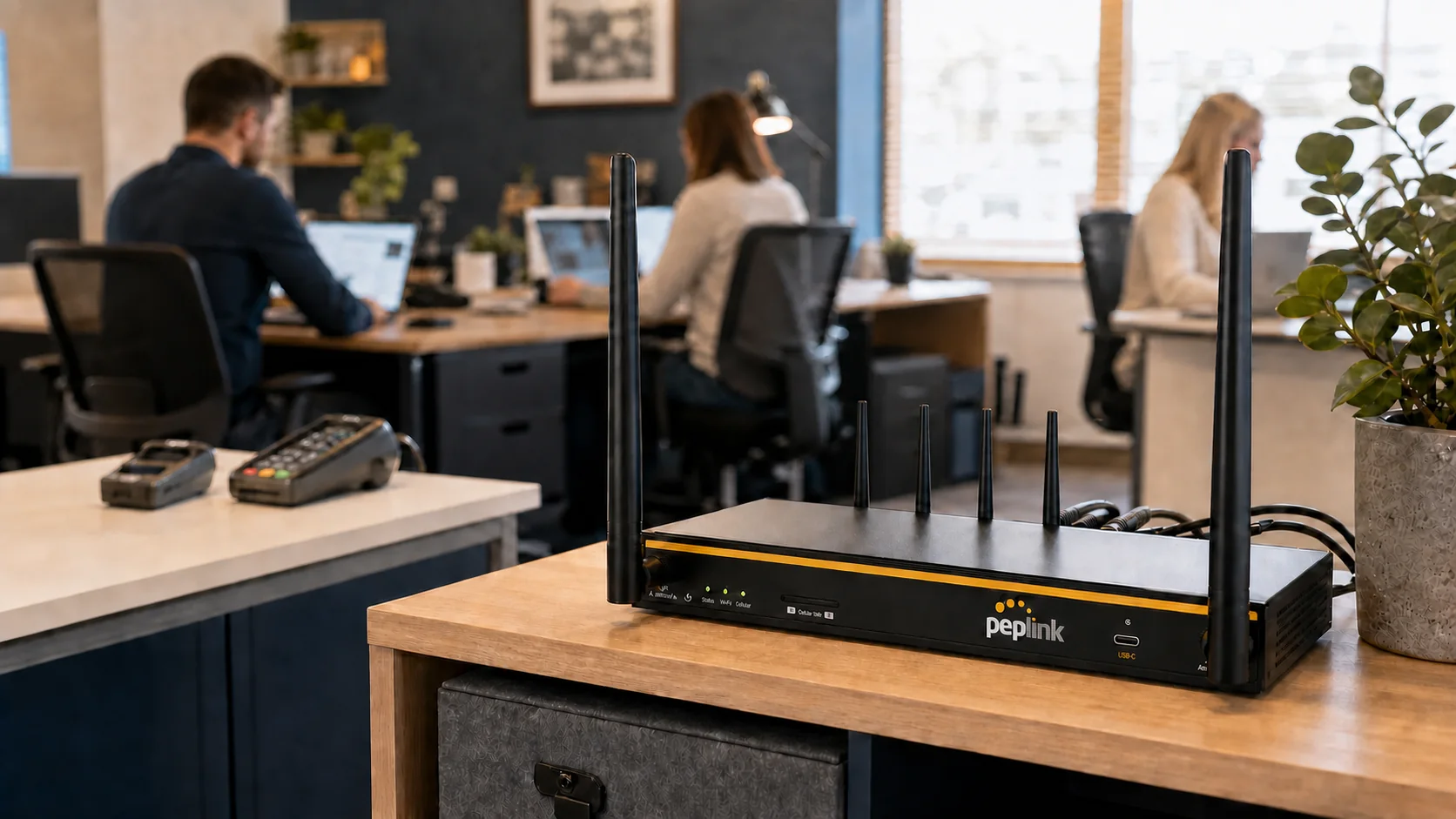
Broadband failure is a case of when, not if. FTTP is highly reliable and SoGEA is a proven business connection, but neither can remove every risk. Cables are damaged, equipment develops faults, engineers disturb working circuits and provider networks occasionally have bad days.
For a small business, even a short interruption can stop card payments, cloud software, phones and customer service. A dropped Microsoft Teams meeting is also more than an inconvenience when a customer, candidate or supplier is on the other end.
The sensible objective is therefore not to pretend broadband never fails. It is to make a single fixed-line fault far less likely to become a business outage.
One router, two different ways to reach the internet
Our small-business resilience design uses a Peplink B One 5G. Your main connection—normally FTTP or SoGEA broadband—connects to its Ethernet WAN port. A business mobile SIM provides the second path through the router's built-in 5G modem.
During normal operation, the fixed line carries the traffic. The router continually checks that the service is genuinely usable, rather than merely trusting that a cable is plugged in. If the fixed path fails its health checks, traffic can move to the cellular connection automatically.
The two paths fail in different ways. A damaged Openreach cable should not take down the mobile network, while a fault at the mobile operator should not affect the fixed broadband. Combining them therefore decreases the odds of both being unavailable at the same time significantly.
Why ordinary failover can still drop a Teams call
Basic dual-WAN routers can send new traffic over a backup connection after the primary fails. The problem is that an existing internet session normally still sees an abrupt change of route and public IP address. A live Teams or VoIP call can disconnect even though the backup is ready a few seconds later.
Peplink SpeedFusion Hot Failover addresses that problem. Traffic which needs continuity travels through a SpeedFusion tunnel. The tunnel is established across the available connections, so if the FTTP or SoGEA path disappears, the router can transfer the active traffic to 5G while preserving the session.
With SpeedFusion correctly configured and a healthy cellular connection, your Teams meeting should continue without requiring you to reconnect. The same approach can protect VoIP calls, payment terminals, remote desktops and other applications that do not respond well to an IP address changing mid-session.
Keep the important traffic moving first
A 5G backup may not have the same capacity or consistency as the primary FTTP service. That is why good failover design is about more than inserting a SIM. We can prioritise voice, video, payment and essential business applications while limiting guest Wi-Fi, cloud backups and large downloads during an outage.
The mobile network, signal strength, antenna position and available data allowance all matter. We check coverage and test the real failover behaviour instead of assuming that a strong signal icon guarantees a good service. The result is a backup connection designed for the applications the business actually needs.
Recover the fixed line faster with Ethernet over FTTP
Cellular backup keeps the business operating, but the objective is still to restore the primary service quickly. For sites in a suitable coverage area, Ethernet over FTTP (EoFTTP) can strengthen the fixed side of the design.
EoFTTP uses Openreach FTTP access but is delivered as a business Ethernet service. BT Wholesale publishes a seven-hour target fix time for Ethernet over FTTP. That can be a substantial improvement over the repair target attached to an ordinary broadband service.
The seven hours is a target under the applicable service terms, not a promise that every fault will be fixed within exactly seven hours; access, major incidents and matters outside the provider's control can affect restoration. Even so, pairing EoFTTP with 5G failover means the business can keep working on cellular while the fixed service receives a much faster repair target. Once it is restored, the business is quickly back to having two available paths.
What this design does not protect against
Resilience works only when its limits are understood. A Peplink B One 5G with fixed and cellular connectivity removes several common failure points, but it is not literal invincibility.
- A power cut: the router, Openreach ONT and any necessary switches or wireless access points still need electricity. If power loss is a concern, we can supply a suitably sized uninterruptible power supply (UPS) to keep the essential equipment running.
- A failure of the router itself: both connections pass through the B One 5G, so one hardware fault could interrupt them both. Where there is zero tolerance for an outage, we can provide high-availability router, firewall and switching options that remove this single point of failure.
- Poor mobile service: cellular backup depends on usable local coverage and an operational mobile network. The SIM, provider, signal and antenna arrangement should be selected and tested for the site.
- Failures elsewhere on the network: a local switch, wireless access point, handset or cloud application can fail even when both internet paths are healthy.
Resilience should match the cost of being offline
For many small businesses, FTTP or SoGEA, a Peplink B One 5G, a suitable mobile service and SpeedFusion provide an excellent balance of cost and protection. One common broadband fault no longer has to stop the working day, and active calls can continue while the router changes path.
Businesses with a lower tolerance for risk can add EoFTTP and its seven-hour target fix time, UPS-backed power, resilient hardware or additional diverse connections. The right answer depends on the financial and operational impact of five minutes, one hour or one day offline.
Broadband will fail eventually. A layered design makes it dramatically less likely that your customers or team will notice when it does.