
What is Openreach EVAc (Emergency Voice Access)?
When the UK’s traditional telephone network closes on 31 January 2027, some analogue lines will still be connected to it. Some belong to customers who have not acted, some to businesses that have not found every line, and some to equipment that nobody remembers is there.
Openreach’s answer for those leftover lines is EVAc, short for Emergency Voice Access. It keeps a basic analogue phone line working after the Public Switched Telephone Network (PSTN) is retired, but carries the call over a digital voice platform behind the scenes. It is a temporary safety net, not an extension of the deadline.
What is EVAc?
Openreach describes EVAc as “a limited last-resort phone service designed to maintain access to essential calls”. It applies to eligible single lines that are still on Wholesale Line Rental (WLR3) when the PSTN closes, for both residential and business customers.
In September 2026, Openreach estimated that around 1.2 million lines were still on the old analogue network, including around 350,000 business premises. EVAc is designed to keep essential calls working on as many of the remaining lines as possible while providers finish moving customers to digital services over SoGEA and full fibre.
How does EVAc work?
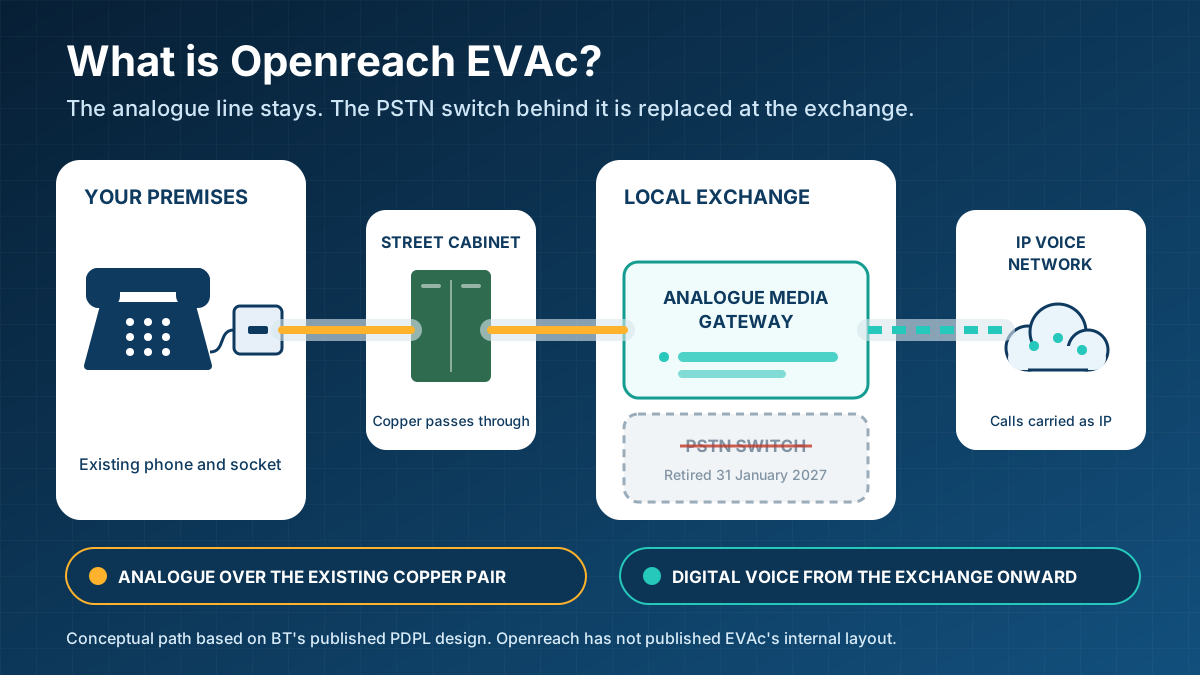
From the customer’s side, very little changes. The same telephone socket and an ordinary analogue handset continue to be used. What changes is where the call goes after it leaves the building.
Openreach has not published an engineering specification for EVAc. It has, however, been described as a much more restricted version of BT Wholesale’s Pre-Digital Phone Line (PDPL), and BT has published how PDPL works:
- The copper stays. Your existing copper pair still runs from the master socket, through the street cabinet, to the local exchange.
- The switch changes. At the exchange, the line is connected to an analogue media gateway instead of a traditional PSTN voice switch.
- The gateway behaves like the old line. It supplies the analogue interface a phone expects, including dial tone, ringing and the electrical conditions for normal operation.
- Speech becomes data. The gateway digitises the call and sends it across BT’s IP voice network.
- Incoming calls reverse the path. They arrive over IP and leave the gateway as an ordinary analogue signal on your copper pair.
The important distinction is that the conversion happens at the exchange, not at your premises. EVAc is not a broadband router with an analogue telephone adapter fitted in your office. It is an exchange-based way of keeping a legacy line working while the equipment that used to serve it is switched off.
Under PDPL, the exchange powers the line, so a corded phone can keep working without a powered router on site. Openreach has not confirmed every detail for EVAc, so check how the line will behave in a power cut with your provider before relying on it.
What does EVAc support?
EVAc deliberately offers less than the line it replaces. Based on Openreach’s announcements and its briefings to providers:
| Capability | EVAc |
|---|---|
| Basic calls on an analogue phone | Yes. Keeping essential calls working is the purpose of the service. |
| Existing line and number | The line is migrated rather than replaced, so the number should stay with it. |
| Calling features | A reduced set. Wholesalers list Caller Display, Withhold Number and Anonymous Call Reject, with many other features withdrawn. |
| Carrier Pre-Select and Indirect Access | Not supported. |
| Linked broadband | ADSL, FTTC and G.fast kept running where technically possible, but not on every line. |
| ISDN2, ISDN30 and multiline | Not covered. These services cease if they are still live after 31 January 2027. |
| Alarms, lift lines, telecare, fax and card terminals | No assurance of compatibility. Earlier briefings said EVAc would not carry critical alarm or lift signals. |
| Long-term use | No. EVAc is temporary and Openreach has not published an end date. |
The broadband change is recent. When Openreach announced an EVAc pilot in April 2026, the service was voice-only and broadband was removed before a line moved across. On 24 September 2026, Openreach said it would keep linked broadband running where it can, but it has not yet said which lines will qualify.
Who will be moved onto EVAc?
EVAc is not something you or your provider can choose in advance. Openreach says it cannot be ordered ahead of time, capacity is not unlimited and places cannot be reserved. Single lines that cannot be moved to EVAc will be ceased by Openreach in tranches.
Wholesalers also report that lines will move exchange by exchange, with no guaranteed schedule and little control for providers over when a particular line moves. Openreach plans to prioritise lines it knows are used for telecare or critical national infrastructure, but that depends on the records it holds.
Key EVAc dates
- 31 January 2027: the PSTN closes, and it is the last date for providers to place migration orders. The deadline has not moved.
- 1 February 2027: new WLR3 prices and terms begin, and managed moves to EVAc start with voice-only lines.
- 31 March 2027: migration orders that cannot complete by this date will be cancelled.
- Mid-April 2027: Openreach expects to start moving lines that have broadband attached.
These dates come from Openreach’s September 2026 briefing to providers and may change, so check the latest position with your provider.
What will EVAc cost?
From 1 February 2027, Openreach will charge providers £35 a month for WLR3 Basic and £38.60 a month for WLR Premium, excluding VAT. The rental applies to every WLR3 single line, whether it has already moved to EVAc, is in the process of moving or is still waiting.
Those are wholesale prices. Your provider will add its own charges for calls, support and billing, so the price you pay will be higher. Openreach itself describes EVAc as more expensive than modern digital alternatives.
Why EVAc should not be your switch-off plan
EVAc exists to stop people losing essential calls overnight. For a business, relying on it creates several problems:
- It is not guaranteed. Capacity is limited and a line may be ceased instead of migrated.
- You cannot choose the timing. Lines move when Openreach reaches the exchange, not when your business is ready.
- Features disappear. Calling features your team relies on today may stop working.
- Connected equipment may fail. Alarms, lift phones and payment terminals have no promise of compatibility.
- It costs more. You pay a higher price for a reduced service.
- You still have to move later. Leaving EVAc is not a managed migration. Wholesalers report it needs a new digital order, a separate cease and a number port where possible.
What to do now
If any of your lines could still be on the PSTN, the steps are the same as they were before EVAc was announced:
- Find every line. Check bills, sockets, comms cabinets, lifts, alarm panels and remote buildings.
- Find out what each line does. A line with no handset attached may still be running an alarm or door entry system.
- Talk to equipment maintainers. Ask what connection each alarm, lift or terminal supports after the PSTN closes.
- Order the replacement now. Move voice to a digital service, such as a 3CX phone system or a VoIP line over SoGEA or full fibre.
- Test before the old line goes. Confirm incoming and outgoing calls, emergency routes and any connected equipment.
Our guide to preparing for the Big Switch Off covers the audit and testing steps in more detail.
Details are based on Openreach’s 24 September 2026 announcement and its briefings to providers as reported by ISPreview. Openreach has not published a full technical specification for EVAc, and its eligibility, features and dates may change.