
What is Openreach RO2 (Resilience Option 2)?
Ordering two leased lines sounds like a sensible way to protect a business from an outage. The problem is that two circuits can still pass through the same underground duct, enter the building together or depend on the same piece of equipment. One incident can then interrupt both services at once.
Openreach Resilience Option 2, usually shortened to RO2, is designed to reduce that risk. It provides a planned pair of diversely routed circuits instead of treating two connections as unrelated orders.
What does RO2 provide?
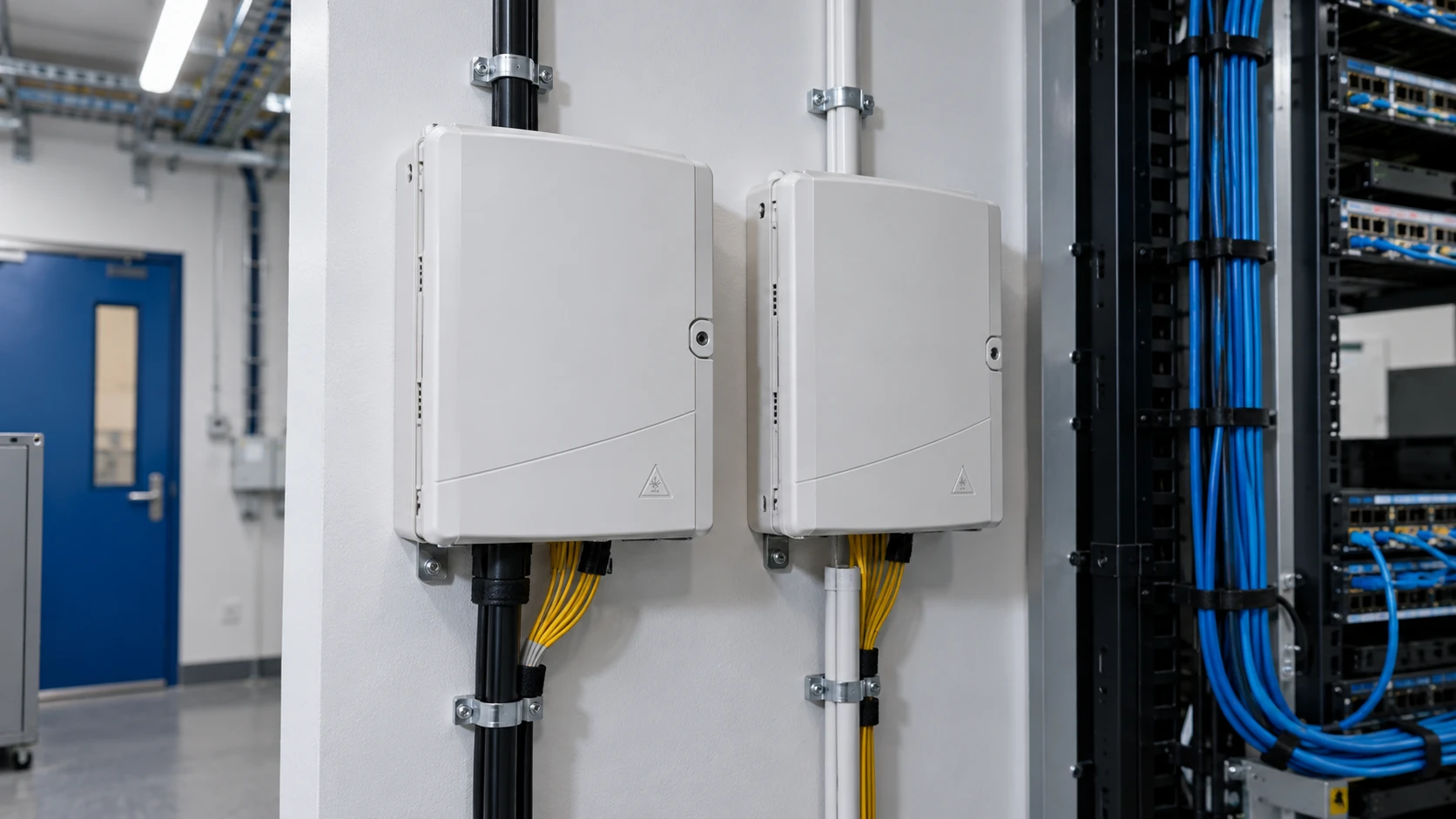
RO2 is an Openreach resilience option for compatible Ethernet and optical connectivity services. The design uses a primary circuit and a secondary circuit, with separate network terminating equipment (NTE) for each service. Openreach plans the two paths as a resilient pair and maintains the recorded diversity between them.
Wherever the available infrastructure allows, the routes use different cables, ducts and building entry points. This makes the pair less vulnerable to events such as a cable cut, a damaged duct or a failure of one NTE. The exact design is subject to survey, so the proposed separation should always be reviewed before the service is ordered.
RO2 does not provide automatic failover
The two Openreach circuits do not automatically move your traffic from one route to the other. That switching needs to be handled by the service provider or by equipment at the customer site, such as routers, firewalls or an SD-WAN platform.
This distinction matters. Diverse fibre can keep a second path available during a fault, but a poor failover design can still leave users offline. The switching method should be configured, monitored and tested before the business depends on it.
What can RO2 protect against?
A well-designed RO2 service can reduce exposure to several common access-network failures:
- A fibre or cable being damaged by roadworks or construction.
- A fault affecting one duct, chamber or local route.
- A failure of one Openreach NTE.
- A problem affecting one building entry point.
- Some node or exchange risks, where the ordered design includes suitable separation.
It is protection against specific shared components, not a promise that the entire business network can never fail. The access route is only one part of an end-to-end service.
What is outside the RO2 design?
RO2 concerns the Openreach portion of the circuits. Your wider service can still contain common points beyond that boundary. Both connections might feed the same carrier core, depend on one firewall, use one electrical supply or terminate in the same communications cabinet.
For meaningful end-to-end resilience, also check:
- Whether the circuits use independent provider core paths and points of presence.
- Whether each circuit terminates on separate customer equipment.
- How routing and failover will operate when either circuit is lost.
- Whether switches, firewalls and wireless networks have their own single points of failure.
- Whether equipment is protected by genuinely independent power and UPS arrangements.
RO2 versus two separately ordered circuits
Two standard circuits, even when bought from different suppliers, are not automatically route-diverse. They may use the same Openreach cable or duct because the orders were planned independently and neither supplier has visibility of the full end-to-end design.
With RO2, Openreach treats the circuits as a related pair and plans for diversity within its network. That gives the communications provider a much stronger basis for confirming which access components are separate. It does not remove the need to check the carrier network and customer site, but it deals with a risk that buying a second ordinary line can easily miss.
What is the difference between RO1 and RO2?
Resilience Option 1 can provide separate fibres and termination equipment, but the fibres may follow a common physical route. It can protect against some equipment or individual fibre faults while remaining exposed to a single cable cut or duct failure.
RO2 goes further by planning diverse physical paths for the paired circuits. It is normally the more suitable option when the main concern is a local civil-engineering incident taking both connections down together. Read our wider guide to designing true network resilience for the other layers that should be considered.
How can RO2 be arranged?
Openreach describes three broad termination arrangements:
- Same-site: both circuits connect the same A-end and B-end locations.
- Split-site: the circuits share one end but terminate at two different sites at the other end.
- Dual-site: the circuits use different locations at both ends.
The right arrangement depends on what the business is trying to protect. A same-site pair may be appropriate for resilient internet access, while split-site or dual-site designs can support data centres, disaster recovery locations and geographically separated infrastructure.
Questions to ask before ordering RO2
- Which cables, ducts, entry points, nodes and exchanges will be separate?
- Are there any unavoidable sections where the planned routes come together?
- Will the two services use different carrier core networks or backhaul paths?
- Who is responsible for failover, and how quickly should it complete?
- Will the routers or firewalls also be deployed as a resilient pair?
- What testing will be completed at handover and during the life of the service?
- What construction work, wayleaves, lead times and additional charges may apply?
Is RO2 right for your business?
RO2 is most relevant where a loss of connectivity would stop operations, interrupt customer services, breach an availability commitment or create a significant financial risk. It may be excessive for a small site that can operate temporarily over a mobile connection, but valuable for a busy headquarters, healthcare location, production facility, contact centre or data-centre environment.
The decision should start with the cost and consequence of an outage. From there, the access routes, carrier networks, on-site equipment, power and failover method can be designed to match the actual business risk.
For businesses in the North East, our page on leased lines in Newcastle covers the networks we compare for primary and backup circuits.
Technical details are based on the Openreach RO2 fact sheet. Product availability and final routing remain subject to survey and order-specific design.